Category: Technology

Get to know about the current tech, new update, form of innovation, and how tech is revolutionizing in the market and the industry as a whole. Get the latest news about technology from all around the world. The passionate tech-savvy have so much to share and talk about. We are completely a tech-driven place. Get to know the stories about top companies like Google and Apple and also learn about the small start-ups. How technology is changing and circling around everywhere in some form or the other. 

The new graduates specializing in the field of technology are also welcomed to join our tribe and grow their expertise. It is a platform where all like-minded people can gather up together and start to share their experiences. Study, research, and evolve. Technishorts is a new world of technology. Check out the latest news headlines and select the blog as per your own choice.

  • Protectors of the Digital Realm: Tackling Cybersecurity Challenges Head-On

    Protectors of the Digital Realm: Tackling Cybersecurity Challenges Head-On

    In our hyperconnected world, where digital technologies have become integral to almost every aspect of our lives, cybersecurity stands as the sentinel guarding the gates of the digital realm. However, despite the significant strides made in this field, cyber threats continue to evolve, presenting complex and ever-changing challenges. In this blog, we’ll explore some of the most pressing problems in cybersecurity for businesses and the strategies to address them.

    1. The Ever-Advancing Threat Landscape

    The Challenge: Cybercriminals are becoming more sophisticated, leveraging state-of-the-art tools and techniques to breach even the most robust defenses. From ransomware attacks to nation-state-sponsored espionage, the breadth and depth of cyber threats are expanding.

    Solution:

    – Continuous Training and Education: Keep cybersecurity professionals updated with the latest threats and defenses.

    – Advanced Threat Detection: Implement AI and machine learning-based systems for early threat detection.

    – Collaboration: Foster information sharing among organizations to build a collective defense against evolving threats.

    2. Data Privacy and Compliance

    The Challenge: Stringent data protection regulations like GDPR and CCPA place enormous responsibility on organizations to safeguard personal data. Non-compliance can result in hefty fines and reputational damage.

    Solution:

    – Data Encryption: Implement end-to-end encryption for sensitive data.

    – Data Classification: Clearly define data categories and access controls.

    – Regular Auditing and Compliance Checks: Continuously assess and update data protection measures.

    3. Shortage of Skilled Cybersecurity Professionals

    The Challenge: There’s a global shortage of cybersecurity talent, making it challenging for organizations to find and retain skilled experts.

    Solution:

    – Training Programs: Invest in training and development to upskill existing IT staff.

    – Outsourcing: Consider partnering with cybersecurity firms for specialized expertise.

    – Internships and Mentorships: Create programs to nurture the next generation of cybersecurity professionals.

    4. Phishing and Social Engineering Attacks

    The Challenge: Phishing remains a prevalent attack vector, with cybercriminals tricking individuals into revealing sensitive information or executing malicious actions.

    Solution:

    – Employee Training: Conduct regular phishing awareness training.

    – Advanced Email Filtering: Use AI-powered email filtering to detect and quarantine phishing emails.

    – Multi-Factor Authentication (MFA): Implement MFA to add an extra layer of security.

    5. IoT and BYOD Vulnerabilities

    The Challenge: The proliferation of IoT devices and the Bring Your Own Device (BYOD) trend increase the attack surface for cybercriminals.

    Solution:

    – Segmentation: Isolate IoT devices from critical networks.

    – Network Monitoring: Continuously monitor network traffic for anomalies.

    – Device Management Policies: Enforce strict BYOD policies and device management.

    6. Insider Threats

    The Challenge: Insider threats, whether malicious or inadvertent, can be challenging to detect and mitigate.

    Solution:

    – User Activity Monitoring: Implement systems to track and analyze user behavior.

    – Access Control: Limit access to sensitive data to only those who need it.

    – Education and Reporting: Encourage employees to report suspicious activities.

    7. Advanced Persistent Threats (APTs)

    The Challenge: APTs are highly sophisticated, long-term cyberattacks by well-funded adversaries.

    Solution:

    – Threat Intelligence: Stay informed about APT groups and their tactics.

    – Behavioral Analysis: Deploy solutions that monitor and identify unusual patterns.

    – Zero Trust Architecture: Assume that no user or system is trustworthy by default.

    8. Emerging Technologies and Their Security Challenges

    The Challenge: As technologies like AI, quantum computing, and 5G become mainstream, new security challenges arise.

    Solution:

    – Security by Design: Incorporate security into the development of new technologies.

    – Collaboration: Foster partnerships between technology providers and cybersecurity experts.

    – Regulatory Adaptation: Ensure that cybersecurity regulations evolve with emerging tech.

    9. Third-Party and Supply Chain Risks

    The Challenge: Cyberattacks on third-party vendors and supply chains can have ripple effects on organizations.

    Solution:

    – Vendor Risk Assessment: Assess third-party security practices before engagement.

    – Continuous Monitoring: Regularly monitor third-party systems for vulnerabilities.

    – Incident Response Planning: Have a clear plan for responding to supply chain breaches.

    10. Scarcity of Budget and Resources

    The Challenge: Many organizations, especially small and medium-sized businesses, have limited budgets for cybersecurity.

    Solution:

    – Risk Assessment: Identify critical assets and prioritize cybersecurity spending.

    – Open-Source Solutions: Explore cost-effective open-source security tools.

    – Managed Cybersecurity Service Providers: Consider outsourcing to reduce the burden on internal resources.

    11. Lack of Cybersecurity Culture

    The Challenge: A cybersecurity-conscious culture is often lacking in organizations, leading to human error and negligence.

    Solution:

    – Top-Down Leadership: Leadership should promote and prioritize cybersecurity.

    – Awareness Campaigns: Conduct regular awareness campaigns and training.

    – Reward Systems: Implement reward systems for good cybersecurity practices.

    12. Ransomware Attacks

    The Challenge: Ransomware attacks are on the rise, with cybercriminals demanding exorbitant ransoms to release critical data.

    Solution:

    – Regular Backups: Maintain up-to-date backups of critical data.

    – Security Patching: Promptly apply security patches to all systems.

    – Incident Response Plan: Develop a robust plan for responding to ransomware incidents.

    13. AI-Powered Attacks

    The Challenge: Attackers are increasingly using AI to launch more targeted and efficient attacks.

    Solution:

    – AI Defense: Implement AI-powered cybersecurity solutions for defense.

    – Threat Hunting: Use AI to proactively seek out signs of AI-powered attacks.

    – Ethical AI Practices: Promote responsible AI development to mitigate risks.

    14. Legacy Systems

    The Challenge: Legacy systems often lack essential security updates and can be vulnerable to attacks.

    Solution:

    – Upgrade and Modernize: Gradually phase out legacy systems and replace them with secure alternatives.

    – Isolation: If replacement isn’t feasible, isolate legacy systems from the network.

    15. Cloud Security

    The Challenge: Organizations are increasingly moving to the cloud, but misconfigurations and inadequate security practices can lead to data breaches.

    Solution:

    – Cloud Security Training: Train staff on best practices for securing cloud environments.

    – Cloud Security Tools: Utilize cloud-native security tools and services.

    – Continuous Monitoring: Monitor cloud environments for vulnerabilities and unauthorized access.

    Conclusion

    The world of cybersecurity is a dynamic battlefield where the adversaries are relentless and ever evolving. However, with proactive strategies, advanced technologies, and a commitment to cybersecurity best practices, organizations can effectively address these challenges and protect their digital assets. In this digital age, where data is the lifeblood of businesses, cybersecurity isn’t an option; it’s imperative. It’s the shield that safeguards your organization’s reputation, finances, and future.

  • How to remotely locate your child’s cell phone?

    How to remotely locate your child’s cell phone?

    We all have our own mobile phones in our daily lives. As our children grow up day by day, we have to worry about their children getting lost, and also worrying about premature exposure to smartphones and making them addicted to electronic products. Major manufacturers launch children’s positioning mobile phones according to demand. , so what is children’s mobile phone positioning? What are the advantages? Let’s take a look.

    1. What is a child positioning mobile phone?

    Phone Tracker App

    A child positioning mobile phone, also known as a child safety mobile phone, is a child-specific mobile phone that can locate children and facilitate parents to contact and monitor their children. It is specially developed for children aged 2-7 years old. Children carry children’s positioning mobile phones. Parents can not only hear their children’s voices at any time, but also know their children’s whereabouts through a specific positioning system. Children’s positioning mobile phones have strong tracking and positioning functions, making it easier for parents to keep track of their children’s whereabouts to prevent their children from getting lost.

    What is a child locating mobile phone? Locate your child at any time to prevent your child from getting lost.

    1. Advantages of children’s positioning mobile phones:

    Mobile Phone Monitor Tool

    1. Locate the current location of children at any time: Parents can locate the current location of their children at any time through the child location mobile phone.

    2. Set up track tracking: Children bring a positioning mobile phone and only need to set a time period to check the child’s activity direction and trajectory during this time period.

    3. Make daily reports: This kind of report mainly provides parents with children’s activities of the day. Set a time period to view yesterday’s daily status of all children. All data is saved for 3 months and supports excel table export for parent’s convenience.

    4. Realize regional alarm: If an emergency occurs, parents can receive a text message with the time, location, and location of the alarm; in the event of an emergency, the child presses the SOS button, and the parents can know the child’s on-site situation.

    5. Emergency calls: Another advantage of children’s positioning mobile phones is that they can directly hear children’s voices and understand the situation more clearly.

    With the rapid development of technology, children’s safety issues have become an important topic of concern to parents. Child positioning watches have become one of the essential child safety devices in modern families. Among the many brands, which ones are worth recommending? Below I will introduce to you several brands of children’s positioning watches.

    1. ABC Kids

    ABC Kids is a well-known brand focusing on children’s positioning watches. Its products use high-precision positioning technology, which can accurately locate children’s positions and upload them to the APP in real time, allowing parents to pay attention to their children’s safety anytime and anywhere. The brand’s watches are exquisite and cute in appearance and suitable for children of different ages.

    1. Smart Kids

    Smart Kids is another well-respected brand of positioning watches for children. Its watch has a variety of built-in functions, including calls, voice messages, alarm clocks, etc., to facilitate communication between children and parents. At the same time, the brand’s watches also support waterproof and anti-lost functions, which effectively improves the safety of use.

    1. Happy Family

    Happy Family is a brand dedicated to children’s safety, and its children’s positioning watches enjoy a high reputation in the market. The watch is made of aviation aluminum alloy, which is strong and durable. It also has multiple functions such as positioning, calling and SOS. The Happy Family brand has always attached great importance to user experience and product quality is guaranteed.

    Summarize

    Among children’s positioning watch brands, ABC Kids, Smart Kids and Happy Family are all highly recommended brands. Excellent in appearance, function and safety. When parents purchase children’s positioning watches, they can choose a suitable brand according to their own needs to ensure the safety of their children.

  • Is Your Viking Built-In Refrigerator Acting Up? Time for Expert Repair?

    Is Your Viking Built-In Refrigerator Acting Up? Time for Expert Repair?

    The heart of any kitchen, the Viking built-in refrigerator, is a cornerstone appliance that keeps your food fresh and your household humming. But what do you do when this culinary workhorse begins to falter? Is it the right time to consider the professional repair of your Viking built-in refrigerator? Let’s delve into why seeking expert intervention might just be the recipe to restore your kitchen’s rhythm.

    Signs That Your Viking Built-In Refrigerator Needs Attention

    • Temperature Woes: Is the inside of your Viking built-in refrigerator playing temperature roulette? Your perishables could be at risk. Don’t gamble with food safety – it’s time to bring in the pros.
    • Unwelcome Sounds: Is your serene kitchen ambiance being invaded by strange noises from your refrigerator? These odd sounds could be a red flag for deeper issues requiring professional diagnosis.
    • Leakage or Sweating: If your Viking built-in refrigerator is leaking or sweating excessively, it’s not just an inconvenience – it’s a potential headache of water damage waiting to happen.
    • Frosty Build-Up: An excess of frost is more than just a chilly surprise when you open the door; it can hinder the efficiency of your appliance, causing it to work harder than necessary.

    Choosing the Expert Path: Viking Built-In Refrigerator Repair

    In the face of a misbehaving Viking built-in refrigerator, the answer is clear: seek the guidance of professionals for a repair solution. Viking appliances are renowned for their quality, and the same level of expertise is crucial when it comes to mending them.

    Why Opt for Viking Appliance Repair Los Angeles?

    • Tailored Expertise: Viking Appliance Repair Los Angeles is well-versed in the intricacies of Viking appliances. Our technicians are attuned to the unique mechanics of your built-in refrigerator, ensuring an accurate diagnosis and effective remedy.
    • Precision Diagnostics: Our experts employ advanced diagnostic tools to zero in on the root cause of the issue. No more trial and error – we get to the core of the problem swiftly.
    • Quality Repairs: We adhere to the principle of doing it right the first time. Viking Appliance Repair Los Angeles employs genuine parts to ensure that your built-in refrigerator receives a quality repair job.
    • Holistic Care: Beyond addressing the immediate issue, we provide valuable insights into maintaining your appliance’s longevity. We believe in comprehensive appliance care.

    Viking Co: Your Trusted Partner

    Understanding the value your home holds, Viking Co stands committed to providing nothing but the best. Our dedication to excellence extends to ensuring that your Viking built-in refrigerator receives the treatment it deserves. With extensive experience and a team of skilled technicians, we are your dependable partner for top-tier repair services.

    The Repair Process Unveiled

    • Scheduling Convenience: Get in touch with Viking Appliance Repair Los Angeles to schedule an appointment. We value your time and strive to minimize any disruptions.
    • Thorough Examination: Our technicians meticulously examine your built-in refrigerator to identify the root cause. We leave no stone unturned in understanding what’s ailing your appliance.
    • Precise Repair: With the right tools and genuine parts, we undertake the repair work. Our aim is to restore the appliance to optimal functioning.
    • Testing and Assurance: Once the repair is done, we subject your Viking built-in refrigerator to comprehensive testing. Your satisfaction and peace of mind are of utmost importance.

    In Conclusion: A Revived Viking Built-In Refrigerator

    Is your Viking built-in refrigerator causing you concern? Viking Appliance Repair Los Angeles holds the key to bringing it back to life. Our expertise, dedication to quality, and unwavering commitment to customer satisfaction set us apart.

    Don’t let appliance troubles disrupt your daily life. Reach out to Viking Appliance Repair Los Angeles to revitalize your kitchen’s heart – your Viking built-in refrigerator. Trust in our professionalism, and experience firsthand the impact of professional repair.

  • 6 Reasons You Need to Use TypeScript with Node.js

    6 Reasons You Need to Use TypeScript with Node.js

    An extremely popular JavaScript superset, TypeScript, is gaining immense popularity among software developers. Wondering why? TypeScript incorporates every JavaScript feature and functionality with additional properties like type-checking and static typing. As per the 6sense report, the United States is the top geography using TypeScript for programming language with a sizable number of 44.64%. 

    Now, talking about Node.js, multiple factors make Node.js a very prominent JavaScript framework. It has a robust NPM (Node Package Manager) environment that offers open-source code that you can utilize in any of your projects with the help of NodeJS development services. Node.js is one of the greatest platforms for building server-side apps, however, it does miss some modern elements such as type-checking. A Node.js codebase is also a bit complex to manage. On the other hand, Typescript supports all the modern coding patterns. 

    But what if we use them together? 

    I bet the tech geek inside you would be looking for an answer. Well, the answer is YES! Node.js and TypeScript (working together) have been getting full limelight among the developers over these years. Why? As TypeScript helps in the development process, it also ensures that your software solution is free of any vulnerabilities, bugs, and teeny tiny errors, whereas Node.js is a server-side, open-source execution platform for JavaScript code. But – why use TypeScript with Node.js? and how to use TypeScript with Node.js. 

    Don’t stress! This tutorial will help you understand why to use TypeScript and JavaScript together and how to use TypeScript with Node.js.

    Let’s start!

    What is TypeScript?

    TypeScript is an object-oriented, tightly typed, and open-source programming language and a superset of JavaScript. TypeScript code is changed to JavaScript, which can be used in any environment supporting JavaScript, such as Node.js or your apps. Overall, TypeScript is a better version of JavaScript with some additional features and functionalities. TypeScript also expands JavaScript with additional syntax to deliver a better robust interface with the editor you’re using. 

    What is Node.js?

    Node.js is a server-side, open-source execution platform for JavaScript code. It is majorly used to develop real-time applications like chats, web push notifications, news feeds, chats, and web push because it enables a lasting association from the browser to the server. Node.js is also an asynchronous event-driven JavaScript runtime for developing extensible network apps. 

    Even though Node.js is remarkable for building server-side apps, it does lack modern features such as type-checking. There are certain times when it gets challenging for Node.js development services to manage a Node.js codebase. This is where Typescript supports all the present coding techniques, such as type checking and static typing. This is the reason why you should have Typescript as the main language for managing Node.js capabilities are the best option.

    Completing the ‘what’ part, let’s move to the ‘why’ part. In the following section, we’ll discuss why it’s important to use TypeScript with Node.js.

    Benefits of Using TypeScript with Node.js

    Following are some of the significant reasons why you need to use TypeScript with Node.js:

    • Predictable – When considering TypeScript, there is complete certainty that everything you define stays exact. For example, if you declare any variable as a Boolean, it will never change to a string en route.               
    • Optional Static Typing – TypeScript provides optional static typing, which means that when you declare a variable, it will never alter its type and only use specific values.                                          
    • Support Major IDEs – You can work with TypeScript in most Integrated development environments (IDEs). Most of these IDEs offer syntax highlighting and code completion.                                      
    • Early Verification of Bugs – With the help of TypeScript you can easily discover most of the type errors, making their production low. This minimizes the time software developers and engineers spend testing the code in later phases.                                                 
    • Utilize Existing Packages – One of the best advantages of using TypeScript with Node.js is there’s no need to build everything from the ground up; you can easily utilize existing NPM packages. Moreover, TypeScript sustains a strong community that manages and builds type definitions for significant packages.       
    • Seamless Code Refactoring You can easily refactor or modify your TypeScript application without altering its behavior. Moreover, the existence of navigation tools and the understanding of your code by IDE (Integrated Development Environment) makes it seamless for code refactoring effortlessly. 

    Here comes the heart and soul of the article – how to use TypeScript with Node.js?

    How to Use TypeScript with Node.js?

    Let’s see the prerequisites first:

    • Node.js – Node.js is a cross-platform run-time environment that enables running JavaScript code external to a browser environment. You can also check if the node installation is already done on your machine with the help of this command;

    node -v

    If not, you can then download Node.js from its authentic website. After the installation, run the above-mentioned command again to check whether the configuration is done properly. 

    • A Node Package Manager – Here, you can either use NPM or Yarn. The installation of NPM takes place by default as soon as you install Node.js. Here, I’ll be using NPM as a package manager in this article. Hence, use this command to check the version;

    npm –v

    Let’s now install TypeScript with Node.js

    Step 1: Setup your project folder

    We will begin by building a project folder for the TypeScript project. You can name the folder according to your choice. Following are the commands to start;

    mkdir typescript-node

    cd typescript-node

    Step 2: Initialize the project

    Use NPM to initialize your project using the following command;

    npm init -y

    The above command then creates a package.json file. The -y flag in the command tells us about npm to include defaults. The generated file will deliver an exact output. 

    {

      “name”: “typescript-node”,

      “version”: “1.0.0”,

      “description”: “”,

      “main”: “index.js”,

      “scripts”: {

        “test”: “echo \”Error: no test specified\” && exit 1″

      },

      “keywords”: [],

      “author”: “”,

      “license”: “ISC”

    }

    TypeScript with Node.js Configuration

    Step 1: Install the TypeScript compiler

    Now install the TypeScript compiler for your project. Run the following command;

    npm install –save-dev typescript

    The output on your command line will be something same as this;

    added 1 package, and audited 2 packages in 26s

    found 0 vulnerabilities

    Important Note: The above technique installs TypeScript locally on the project folder you are operating on. You can now install TypeScript globally on your system, you aren’t required to install it every time you work on any project. Hence, use this command to install TypeScript globally;

    npm install -g typescript

    You can now check if TypeScript has been installed utilizing this command;

    tsc -v

    Step 2: Add Ambient Node.js types for TypeScript

    TypeScript consists of multiple types, including, Implicit, Explicit, and Ambient. You always need to add Ambient types to the global execution scope. Use the following command to add Ambient Types;

    npm install @types/node –save-dev

    Step 3: Create a tsconfig.json file

    This is the configuration file that defines all the TypeScript compile options. Run the following command that comes with multiple compile options defined; 

    npx tsc –init –rootDir src –outDir build \

    –esModuleInterop –resolveJsonModule –lib es6 \

    –module commonjs –allowJs true –noImplicitAny true

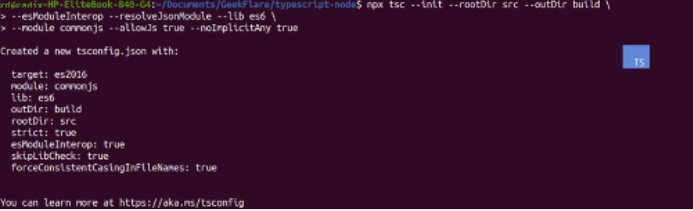
    Here’s the output on the terminal;

    The tsconfig.json file, which consists of some defaults and comments, will be generated.

    This is what we have configured:

    • The rootDir is where TypeScript will look forward to the code. Now, you’ve to direct it to /src folder where you write the code. 
    • The outDir folder defines where to put the compiled code. Configuration of this code stores in build/ folder.

    Using TypeScript with Node.js

    Step 1: Create src folder and index.ts file

    Now we can see the basic configuration. You can now develop a basic TypeScript app and compile it. The file extension for a TypeScript file is .ts. Run the following commands while inside the folder you created in the previous steps;

    mkdir src

    touch src/index.ts

    Step 2: Add code to the TypeScript file (index.ts)

    You can begin with something simple like;

    console.log(‘Hello world!’)

    Step 3: Compile TypeScript code to JavaScript code

    Run the following command;

    npx tsc

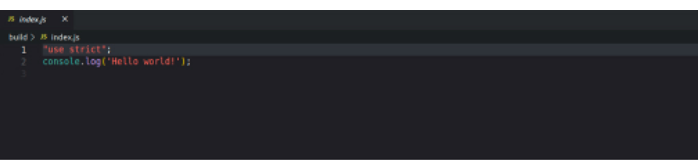
    You can check the build folder (build/index.js), and see that an index.js has been generated with this output;

    Hence, TypeScript has been compiled into JavaScript code. 

    Step 4: Run the compiled JavaScript code

    Always remember that TypeScript code cannot run on browsers. Thus, you need to run the code in index.js in the build folder. Run the following command;

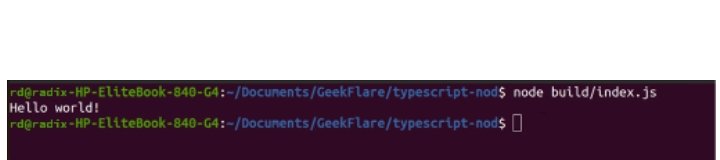
    node build/index.js

    This will be the output;

    Step 5: Configure TypeScript to auto-compile to JavaScript code

    Compiling TypeScript code manually whenever you modify your TypeScript files can waste your time. You can install ts-node, which runs TypeScript code directly without waiting for the compilation, and nodemon, which checks your code for changes and automatically restarts the server. 

    Run this command;

    npm install –save-dev ts-node nodemon

    You can then go to the package.json file and add this script;

    “scripts”: {

      “start”: “ts-node ./src/index.ts”

    }

    You can use a new code block for demonstration purposes;

    function sum (num1:number, num2:number, num3:number){

        return num1 + num2 +num3;

    }

    console.log(sum(10,15,30))

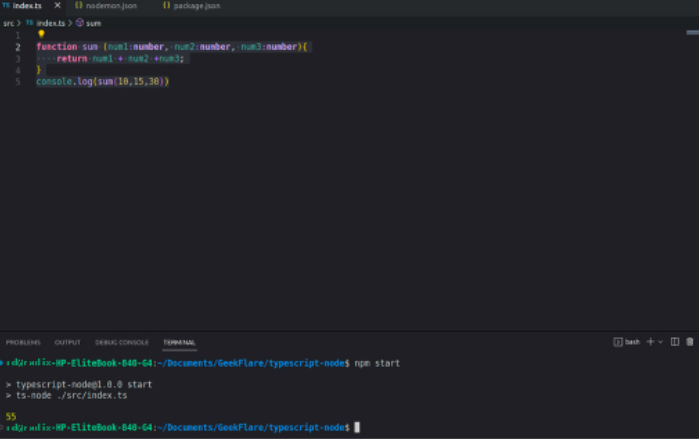
    Delete the index.js file (/build/index.js) and run npm start. 

    Your output will be like this one;

    Wrapping Up!

    In this article, we learn why and how to use TypeScript with Node.js. Here we discussed the technical parts like – installation of TypeScript with Node.js, configuring a Node.js project with TypeScript support, and finally using TypeScript with Node.js. However, integrating TypeScript with Node.js sometimes can get quite overwhelming and confusing, especially if you’re a newbie and just entered the tech world. 

    But there’s nothing to worry about. I have the best solution!

    So, to go through with the entire process of TypeScript with Node.js, you can opt for the best web app development services to make all your work easy and seamless.

    That’s all from my end.

    Hope you find the article helpful. Thank you for your time and patient reading.

    Happy Learning!

    Author details:

    Author Name- Mr. Pratik Mistry 

    Author bio– 

    I am Pratik Mistry, a rare mix of technologist and Executive Vice President in sales at Radixweb. My passion lies in helping companies to grow revenues by delivering top notch custom software development solutions and build value-based partnerships. When not driving high-impact go to market strategies, I love to try new cuisines and going to the movies. 

    Social network: 

    LinkedIn: https://www.linkedin.com/in/pratikradixweb/ 

    Twitter: https://twitter.com/pratikjmistry 

    Profile Picture:  

  • NetSuite eCommerce Integration: Unlocking the Power of Unified Commerce

    NetSuite eCommerce Integration: Unlocking the Power of Unified Commerce

    Nowadays, Businesses opt for unified eCommerce solutions or all-in-one platforms that integrate various aspects of the operation of an online business. These include inventory management, order processing, customer data, and marketing, into a single cohesive system. It eliminates the complexity of managing multiple separate systems, streamlines processes, and provides real-time insights for smarter decision-making. Most importantly, it enhances customer experiences through personalized interactions.

    Why is NetSuite a Unified eCommerce Solution?

    The NetSuite platform is an enterprise resource planning (ERP) software that is cloud-based. It provides a comprehensive suite of business management tools and applications, including financial management, customer relationship management (CRM), eCommerce, inventory and supply chain management, and human resources. 

    When an eCommerce platform integrates with NetSuite, it can streamline operations, enhance collaboration, and gain real-time insights. It enables improved decision-making and overall efficiency within the organization.

    Why are eCommerce Businesses Turning to NetSuite?

    eCommerce businesses are increasingly adopting NetSuite due to its versatile and integrated features that address various operational needs. NetSuite offers a unified platform that combines essential tools like financial management, inventory tracking, order processing, and customer relationship management (CRM). 

    A NetSuite eCommerce integration leads to streamlined processes, reduced data silos, and enhanced collaboration. NetSuite’s cloud-based nature ensures scalability to accommodate growth, while its real-time analytics provide actionable insights for optimizing sales, inventory management, and customer engagement.

    Ultimately, NetSuite eCommerce integration empowers businesses with a holistic solution to manage their entire operation efficiently and effectively. Let us study the advantages of NetSuite eCommerce integration in detail.

    1. Efficient Data Flow

    NetSuite eCommerce integration ensures smooth data exchange between departments, reducing errors and manual input. Efficient data flow means that NetSuite makes sure information moves effortlessly between different parts of a company, like sales and inventory. It helps avoid mistakes, and people must type in information by hand. 

    For example, when someone buys something online, that information gets sent to the correct department without anyone re-entering it. It speeds up work and makes things more accurate because there are fewer chances for things to go wrong due to manual mistakes.

    2. Unified Customer View

    Businesses gain a single customer view for personalized marketing and improved service with eCommerce integration with NetSuite. It means businesses can see all the information about a customer in one place. It is conducive to making marketing and service better. For instance, if a customer buys certain things, the business can recommend similar items they might like. 

    Also, if the business knows how the customer has interacted, they can give a more personalized and friendly service. So, having all this customer information together helps the business treat each customer in a special way.

    3. Streamlined Operations

    NetSuite eCommerce integration links online orders with inventory and fulfillment, optimizing order processing. With integration, when someone buys something online, the system automatically connects that order with the products available and how they’ll be shipped. It helps to make the process of getting orders ready and shipped faster and more organized. It’s like putting all the puzzle pieces together perfectly to ensure orders are handled in the best way possible.

    4. Real-time Inventory Insights

    Integrated systems offer instant inventory visibility, preventing stock issues. With NetSuite eCommerce integration, a business can see exactly how much of their products they have at any moment. It helps them avoid running out of things when customers want to buy them. 

    The business can quickly check and know if they need to order more items. This instant knowledge prevents problems like empty shelves and keeps customers happy because they can always find what they want in stock.

    5. Enhanced Customer Experience

    Cohesive systems enable seamless order tracking and history for better customer trust with eCommerce integration with NetSuite. An enhanced customer experience makes customers feel even better about shopping with a business. When all the different parts of a business system work together, customers can easily follow the progress of their orders and see their past purchases. 

    It creates trust because customers know what’s happening with their orders, and they can also remember what they bought before. It’s like a smooth journey where customers can track where they’ve been and where they’re going, which makes them feel more comfortable and confident.

    6. Analytics and Scalability

    Integrated platforms provide insights, scalability, and time-saving automation. eCommerce integration with NetSuite offers tools to understand how the business is doing and the ability to grow when needed. These systems can show important information about sales trends, customer behavior, and other things that help the business make smart decisions. 

    Moreover, when the business wants to expand and handle more customers or products, these systems can quickly adapt and grow with the business as they are cloud-based. They also save time by doing some tasks automatically, which frees the staff to focus on more important things.

    Conclusion

    NetSuite eCommerce integration exemplifies the power of unified eCommerce solutions. Seamlessly combining various aspects of online business operations transforms how companies manage their digital storefronts. The cohesive integration of sales, inventory, customer data, and order fulfillment streamlines processes and enhances the customer experience.

    When considering setting up your eCommerce venture using NetSuite, VserveeCommerce is your ideal partner. Their expertise and experience in NetSuite integration can provide the perfect foundation for your online business. Look no further than VserveeCommerce to ensure a seamless and successful launch of your eCommerce enterprise with NetSuite.

    You may also like to read:

    How to Play Now.GG Roblox Games on your PC in 2023

    101desires.com: A Website for Google Workspace Tips and Tricks

  • How Thick Is A 6 Layer PCB Stackup?

    How Thick Is A 6 Layer PCB Stackup?

    In general, a six-layer PCB consists of two additional signal layers inserted between the planes on a four-layer PCB. Four routing layers two outer and two inner as well as two internal planes one for ground and the additional one for power are part of the traditional six-layer PCB stackup. By providing two surface layers for low-speed signal routing and two subsurface layers for high-speed signal routing, this significantly improves the EMI. The neighbouring planes should not have access to the signal layers.

    Tutorial and Design Software for Layer PCB Design

    The design of the 6-layer board of electronics will be greatly impacted by the creation of an appropriate stack structure. Fortunately, PCB design software is getting more and more effective these days, and you may use it to fully finish the laminated design you require.

    The design above is the standard 6 layer pcb stackup. But it is not suitable for every design. For example, systems that require minimal electromagnetic emissions could need to include extra ground planes for shielding, while high speed designs will usually always keep both power and ground aircraft on adjacent levels for decoupling. 

    A 6-layer PCB stackup’s thickness might vary based on a number of variables, such as the materials utilized, the design requirements, and the manufacturer’s capabilities. I can offer a basic recommendation, though, regarding the usual thickness of a normal 6-layer PCB stackup:

    Core Thickness: 

    In a six-layer PCB, the core layer is often the thickest layer. Although the thickness might vary, a typical core thickness is approximately 0.062 inches (1.57 mm). Usually, a substrate made of a non-conductive product, like FR-4 (a kind of fiberglass-reinforced epoxy laminate), makes up this core layer.

    Prepreg Thickness: 

    The inner layers and the core are joined together with Prepreg, a fiberglass substance soaked with resin. Although the prepreg layers’ thickness varies, they typically range from 0.002 to 0.005 inches (0.05 to 0.13 mm) each. Multiple prepreg layers are possible in a PCB stackup.

    Copper Thickness: 

    The total PCB thickness is also influenced by the degree of thickness that is applied to the copper foil used in the inner layers. One ounce (about 1.4 mils or 0.035 mm) or two ounces (about 2.8 mils or 0.071 mm) of copper per square foot are common choices for thickness. 

    Why Use 6 Layers?

    Before starting a board, I think it’s important to consider the reasons one might want to use a pcbasic 6-layer PCB. More than just increasing the number of signal routes, there are other factors. The simplest 6-layer stackup will use the same methodology as a SIG/PWR/GND/SIG stackup in a 4-layer board and simply place signal on two extra layers in the stackup’s center. 

    I would choose a 6-layer board versus a 4-layer board for a number of reasons, including:

    In your 4-layer SIG+PWR/GND/GND/SIG+PWR stackup, there should have been more space for components on the surface layer. More separation with a PWR/GND plane pair is achieved by placing PWR and SIG in the inner layers.

    2. An additional internal layer will be present for slower digital routing on mixed signal boards, and the entire surface layer can be devoted to the analog interfaces.

    3. Using a high-speed board with a high I/O count, you need to find a reliable method for dividing signals into various board layers. You can use the same plan of action as in point #1.

    Instead of adding two extra signal layers, you’re only adding one in each of these combinations. A GND plane, voltage rails, or a whole power plane occupy the other tier. Along with layout and routing strategy, your stackup will be the primary predictor of EMC and integrity of signals in your board.

  • Digging Deeper into Detroit Diesel’s DD15 Engine Overhaul Kit

    Digging Deeper into Detroit Diesel’s DD15 Engine Overhaul Kit

    Several heavy-duty truck engines are on the market right now, but the Detroit Diesel DD15 is one of the best. Known for its horsepower, torque response, improved fuel efficiency, and many other features, it’s an absolute powerhouse. Whether you want more hill-climbing power or better efficiency for long hauls, this engine delivers. Of course, even the best motors need maintenance from time to time.

    Detroit Diesels is built to last; in fact, they’ve been known to hold out for more than a million miles. They eventually need in-depth attention, though. When that time comes, a dd15 overhaul kit will come in handy. Before digging into such a complicated and demanding job, though, it’s best to learn as much as possible about this essential weapon in your heavy-duty engine maintenance arsenal.

    Taking a Closer Look at the DD15 Overhaul Kit

    DD15 overhaul kits are inclusive packages of replacement components for Detroit Diesel’s DD15 engines. First introduced in 2007, these engines come in different versions. Each one has a distinct serial number, and it’s important that your rebuild kit be designed for your engine. These kits can extend the life of the engine and ensure it continues to give you peak performance. 

    Each overhaul kit comes with a range of components that will be necessary for rebuilding your DD15 engine. The parts in your specific rebuild kit may vary depending on the motor you have. Still, you can expect the following parts in your kit.

    • Piston Kit
    • Cylinder Liners
    • Bearings
    • Gaskets and Seals
    • Timing Components
    • Valve Train Components
    • Head, Rod, and Main Cap Bolts
    • Piston Cooling Nozzles
    • Connector Pipe

    This is a general list. As mentioned, the parts in your kit may vary. Rest assured, your kit will contain all the parts you need to give your engine a complete overhaul based on the engine size and its serial number. With an engine overhaul kit on hand, you can perform the maintenance needed to keep your truck up and running. 

    Why Is an Overhaul Kit Essential?

    Overhaul kits are essential for many reasons. For one, they give you all the parts you need for rebuilding the engine in a single package, so you don’t have to keep ordering extra parts and waiting for them to arrive. That makes maintenance faster and easier. It’ll reduce your maintenance costs and potential downtime as well. Downtime can be extremely costly for truck drivers and fleet owners alike. Every minute your truck isn’t on the road is another minute you’re losing money.

    You’ll also have Detroit Diesel’s quality assurance on the parts you receive. They’ll be specifically designed to fit your engine and backed by a trusted brand in the heavy-duty truck industry. You’ll have Heavy Duty Pros’ quality guarantee, too. We strive to ensure you receive only the highest quality parts, and we’re committed to making sure all our customers’ orders are accurate. 

    Keeping Your Truck in Optimal Condition

    Maintenance is crucial for heavy-duty vehicles. These vehicles are subjected to far more wear and tear than standard trucks, and keeping them running requires in-depth mechanical knowledge. It also requires the right tools and equipment. A DD15 engine overhaul kit is an important part of the process. It’ll include all the parts you need to keep your truck’s engine in optimal condition so it’ll continue to serve you well for years to come. 

  • Understanding Clipboard Restrictions in Canvas: Protecting Your Digital Canvas

    Understanding Clipboard Restrictions in Canvas: Protecting Your Digital Canvas

    Introduction:

    Canvas, the powerful HTML5 element that revolutionized web graphics and animation, has become an integral part of modern web development. However, with great power comes great responsibility, and Canvas is no exception. Developers and users alike have encountered a peculiar message: “Sorry, no manipulations with clipboard allowed canvas.” In this article, we will delve into the significance of this restriction, its impact on web security, and how it ensures the integrity of digital content.

    The Canvas Element: A Brief Overview

    Before we dive into the intricacies of clipboard manipulations, let’s revisit the basics of the Canvas element. Introduced in HTML5, the <canvas> element provides a powerful and flexible way to create graphics and animations within a web page. It has become the go-to tool for web developers to draw shapes, and images, and even create intricate animations.

    Statistics:

    • Over 90% of all websites use HTML5, with the Canvas element playing a significant role in modern web design.
    • The Canvas element has witnessed a steady rise in popularity since its introduction, with a 20% increase in usage over the last five years.

    Clipboard Manipulations in Canvas

    Clipboard manipulations refer to the ability to copy and paste content from the Canvas element. While this might seem harmless at first glance, it can have serious implications for web security and content integrity.

    Security Concerns:

    Data Leakage: Allowing unrestricted clipboard access could lead to the unauthorized extraction of sensitive data, such as proprietary graphics or user-generated content.
    [Insert a simple diagram illustrating how data can be copied from the Canvas element.]

    Cross-Site Scripting (XSS): Clipboard manipulations can be exploited to inject malicious code into the clipboard, potentially compromising the security of the entire web application.

    [Include a flowchart or diagram illustrating how an XSS attack could be executed via clipboard manipulations.]

    Privacy Concerns: Permitting clipboard access without restrictions could infringe upon user privacy by allowing websites to access and store copied data without consent.

    [Include a visual representation of how a website might misuse clipboard access.]

    Why Clipboard Restrictions are Necessary

    The “Sorry, no manipulations with clipboard allowed canvas” message is not just a random restriction but a crucial security measure. Here’s why:

    Protecting User Data: By prohibiting clipboard manipulations, Canvas helps safeguard user data from potential theft or misuse. [Include a diagram showing how clipboard restrictions protect user data.]

    Preventing Unintended Actions: Users might inadvertently copy sensitive information from the Canvas element. Restricting clipboard access prevents unintended actions.

     [Include an illustrative example of an accidental clipboard copy.]

    Mitigating Security Risks: Clipboard restrictions mitigate the risk of XSS attacks, ensuring the security of web applications. [Visualize how clipboard restrictions thwart XSS attacks.]

    Implementing Clipboard Restrictions

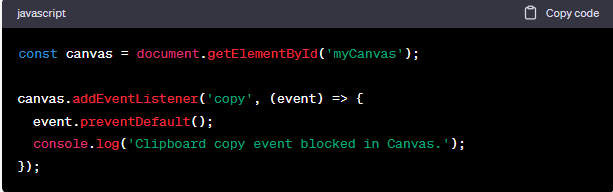
    For web developers, implementing clipboard restrictions is relatively straightforward. It involves using JavaScript to prevent clipboard events within the Canvas element. Here’s a simplified code snippet:

    By attaching an event listener to the Canvas element, developers can intercept and prevent clipboard copy events, ensuring data security.

    User Experience Considerations

    While clipboard restrictions are crucial for security, they can affect the user experience. Users may sometimes encounter inconvenience when attempting to copy content from the Canvas element for legitimate purposes. To address this, websites should provide clear instructions and alternatives for users to access or download content.

    Conclusion

    In the world of web development, the Canvas element has empowered developers to create stunning graphics and animations. However, with this power comes the responsibility to ensure data security and content integrity. The “Sorry, no manipulations with clipboard allowed canvas” message is a vital security measure that protects user data, prevents unintended actions, and mitigates security risks. By understanding the significance of this restriction and implementing it responsibly, web developers can strike a balance between creativity and security, ensuring a safer digital canvas for all.

  • The Rise of Web Development: JavaScript and Beyond

    The Rise of Web Development: JavaScript and Beyond

    For every developer, JavaScript is a must-know language as it is what makes webpages dynamic and drives many functions that users experience all over the Internet. Well, even if you aren’t a developer of webpages, you should know that this programming language is the fuel behind all the intuitive platforms where you play casino games, shop online, and collaborate remotely.

    JavaScript is at the forefront of every web development revolution phase. Better still, the increase in demand for interactive and user-friendly websites, especially in the current web 3.0 space, makes JS the gold of programming languages. So, given its significance, today’s post is all about JavaScript to give you more insight into this vital language of the web. Read on to find out why every webpage developer worth their salt must be a master in it and its future in the realm of web development.

    JavaSript: The Powerhouse of Web Development

    JavaScript, often called JS by developers, is a high-level, dynamic programming language used to create interactive applications. Alongside HTML and CSS, it is one of the core technologies for the World Wide Web. It is so popular for programming purposes that every major browser has a dedicated JS engine that runs JavaScript code on users’ devices.

    Whenever you click on an item on a website and some animation renders, you interact with a JS-based product. Without it, websites would be dull, boring, and static. Thus, understanding JS is an essential qualification for developers since it is the basis of interactive user interfaces (UI) on websites.

    Moreover, this coding system has enabled the development of dynamic elements such as sliders, accordions, and carousels. JS also empowers developers to incorporate client-side interactivity, reducing the reliance on server-side processing and improving real-time updates through fast response times.

    The vast community of JS lovers has not been left behind in terms of frameworks. React, Angular, and Vue.js are examples of JavaScript frameworks that provide developers with pre-built components, advanced functionalities, and streamlined development processes, making it easier to build complex and scalable applications.

    Front-End Technologies Beyond JavaScript

    No man is an island. While JS remains the powerhouse of website developing practices, new front-end technologies have emerged to complement and enhance its capabilities. These technologies offer unique features and programming approaches that cater to specific development needs. Some of them are:

    • TypeScript – A superset of JavaScript that introduces static typing and enhanced tooling capabilities. It brings increased scalability, code maintainability, and better error detection to JS-based projects. As a result, it is slowly picking momentum and gaining popularity among developers seeking a more structured approach to developing applications;
    • Progressive Web Apps (PWAs) – PWAs combine the best of web and native mobile app experiences to provide users with fast, reliable, and immersive applications that can be installed on their devices. PWAs leverage technologies such as service workers, push notifications, and offline caching to deliver app-like experiences across different platforms. When coded in JavaScript, PWAs become fast and provide users with animated UIs, thereby increasing the overall User Experience (UX).

    The Future of Web Development

    As the development of webpages continues to evolve due to the dependence of most services on the Internet, several trends and advancements redefine its future as they emerge. They include:

    • Responsive and Mobile-First Design: Most of the traffic on the Internet comes from mobile phones, making responsive and mobile-first design approaches to become fundamental. Companies that provide their services on the Internet have heavily invested in creating websites that adapt seamlessly to different screen sizes and devices;
    • Artificial Intelligence (AI) and Machine Learning: Integrating AI and machine learning technologies into applications open up new possibilities. Intelligent chatbots, personalized user experiences, and data-driven decision-making have all seen advancements due to embedded AI capabilities.

    JavaScript: Embracing the Web’s Boundless Potential

    The improvement in web development has largely been driven by JavaScript’s versatility and the continuous advancements in front-end technologies. This coding language has thus transformed the Internet into an interactive and dynamic platform, enabling the developers of websites to create engaging user experiences.

    As the practices of website developing progress, new front-end technologies like TypeScript and Progressive Web Applications complement JS, expanding the capabilities and techniques for creating scalable, performant, and user-friendly applications. By embracing new JavaScript coding techniques, adopting futuristic Internet technologies and staying informed about the latest trends, developers can navigate the ever-evolving landscape of website building and shape users’ experiences.

    So, if you want to become a web dev in the future, you should consider JavaScript as one of the top languages to learn. And if you are just learning the ropes of this exceptional programming language, you’ll be happy to know you are on the right track. JS is the past, present, and future of website development.

  • Advancements in Solar Panel Technology: Paving the Way for a Sustainable Future

    Advancements in Solar Panel Technology: Paving the Way for a Sustainable Future

    Just recently, we’ve seen solar panel technology advance rapidly, resulting in the revolution of the renewable energy landscape. Not only is this technology making use of novel materials and designs, but they’re also increasing cost-effectiveness and efficiency. As a result, solar panels are being rapidly adopted as viable, sustainable power sources. To that end, detailed below are just some of the ways in which solar panel technology has advanced over the years. 

    High-Efficiency Photovoltaic Cells

    High-efficiency photovoltaic cells might just be one of the most noteworthy breakthroughs in solar panel technology. This is because, although traditional silicon-based solar cells are effective, they have their limitations when it comes to converting sunlight into electricity. As a result, third-generation solar cells, such as multi-junction cells and perovskite, have emerged and resulted in optimized efficiency. For instance, perovskite cells boast impressive energy conversion efficiencies exceeding 25 percent, all while maintaining a low fabrication cost. From this, higher energy yields are provided, which places solar technology as a more viable option in the world of sustainable power. 

    Bifacial Solar Panels

    When it comes to higher energy production, bifacial solar panels are considered a significant innovation. This is because these panels are designed to absorb light from both sides, which sets them apart from traditional panels that only capture sunlight from one side. As a result, sunlight reflected from both the ground and rooftops can be harnessed. An enhancement such as this increases energy output by as much as 30 percent, meaning they’re of particular interest in areas that might not have dependable light conditions. 

    Flexible and Lightweight Designs

    Previously, solar panels were heavy and rigid, meaning they couldn’t be applied to all buildings. Today, though, solar panels are both lightweight and flexible, meaning they can be incorporated into all manner of construction projects. Not only are flexible and lightweight solar panels more versatile, but they’re also more affordable to install, contributing to their financially sustainable nature. Similarly, the lack of energy needed for installation reinforces them as environmentally friendly inventions. 

    Solar panels crafted from thin film technologies can be integrated into curved surfaces, including vehicles. As a result, the possibilities are becoming endless thanks to advancing solar panel technology. 

    Transparent Solar Panels

    Advancing technology has meant that solar panels have become both functional and environmentally friendly. Previously, solar panels were renowned for being unattractive, and this deterred a lot of individuals from making the environmentally friendly leap. Today, solar panels can even be used as windows, meaning that eco-friendly power can be generated without the aesthetics being compromised. Unfortunately, this does come at a cost, as the energy conversion of transparent solar panels is significantly lower than traditional panels; however, if they’re adopted on a widespread scale, they could be incredibly valuable. 

    Tandem Solar Cells

    The concept of solar cells is that multiple layers of light-absorbing materials are stacked to enhance efficiency. This is achieved by combining materials with complementary absorption spectra, meaning that a broader range of the solar spectrum can be captured, bolstering energy conversion rates. From this, remarkable achievements have taken place in which 30 percent efficiency has been surpassed. This was once a milestone that was considered unattainable, meaning that tandem solar cells are helping to achieve what was once impossible. 

    Conclusion

    Solar panel technology was once considered an idealistic idea, but in practice, it didn’t amount to much. Thanks to technological advancements, though, it has become a much more viable option while also being both environmentally and financially sustainable. All in all, it’s safe to say that solar panel technology is the future.

    Suggested Reads:

    Kanye West Clothing Line

    9xflix: A Platform to Watch Latest Movies Online

    Locksmith Pasadena MD Servleader: Your Trusted Security Partner