DJIA Futures: Powerful Guide to Dow Jones Futures, Market Trends, and Trading Opportunities

DJIA futures are financial contracts that allow market participants to trade based on the expected future value of the Dow Jones Industrial Average. The Dow, commonly called the Dow Jones or simply the DJIA, tracks 30 major publicly traded US companies. These companies represent several sectors of the American economy, making the index a widely followed indicator of stock-market performance.
Unlike buying individual stocks, trading Dow Jones futures involves taking a position on the movement of an entire index. Traders can potentially benefit from rising or falling prices, depending on their positions, although losses can also occur rapidly. Investors, financial institutions, and professional traders use these contracts for speculation, hedging, and managing exposure to broader equity-market movements.
Understanding the Dow Jones Industrial Average
The Dow Jones Industrial Average is a price-weighted stock-market index. This means that companies with higher share prices have greater influence on its movements than companies with lower share prices, regardless of their overall market capitalization. Its 30 constituents include established businesses across industries such as technology, finance, healthcare, consumer goods, and industrial production.
The index is frequently used to discuss the health and direction of the US stock market. However, it is not a complete representation of every publicly traded American company. DJIA futures provide a way to trade expectations about this particular benchmark before, during, and after regular stock-market trading hours.
How Futures Contracts Work
A futures contract is an agreement to buy or sell an underlying asset or financial instrument at a specified price, according to standardized contract terms. In the case of DJIA futures, the contract’s value is linked to the Dow Jones index rather than to physical delivery of shares in its 30 companies.
Most index futures traders close or offset their positions before expiration instead of holding contracts to settlement. Futures are also traded on margin, meaning traders deposit a fraction of the contract’s notional value rather than paying the full value upfront. This creates leverage, which can amplify both gains and losses.
How DJIA Futures Work
DJIA futures trade electronically on the CME Group’s futures markets, with trading available for much of the business week. Their extended trading hours allow participants to react to economic announcements, overseas market movements, and breaking developments outside regular US stock-market hours.
A futures quote represents the market’s current price for a particular contract month. For example, a trader who expects the Dow to rise might buy a futures contract, while someone expecting a decline might sell one. The profit or loss depends on the change in the contract price, the contract’s multiplier, and the number of contracts held.
E-mini and Micro E-mini Dow Futures
Traders commonly encounter two contract sizes: E-mini Dow futures and Micro E-mini Dow futures. Both track the Dow Jones Industrial Average, but their contract multipliers differ, making them suitable for different position sizes.
|
Contract |
Symbol |
Contract multiplier |
|---|---|---|
|
E-mini Dow |
YM |
$5 × DJIA |
|
Micro E-mini Dow |
MYM |
$0.50 × DJIA |
For example, if the index moves 100 points, one E-mini Dow contract changes in value by $500, while one Micro E-mini contract changes by $50, before fees and other trading costs. Smaller contracts can make it easier to adjust exposure, but they do not remove the risks associated with leverage.
What Moves DJIA Futures Prices?
DJIA futures prices respond to changing expectations about corporate profitability, economic growth, inflation, interest rates, and investor confidence. Because futures trade outside regular stock-market hours, international developments and overnight announcements can also influence their prices.
Economic Reports and Federal Reserve Decisions
Economic indicators are among the most important influences on Dow futures. Employment reports, inflation figures, consumer spending, manufacturing activity, and gross domestic product (GDP) can change expectations about the US economy. Strong economic growth may support stock prices when investors expect higher earnings, but unexpectedly high inflation can create concerns about interest rates and borrowing costs.
The Federal Reserve also plays an important role. Its interest-rate decisions, policy statements, and economic projections can move futures rapidly because they influence the expected cost of money and the valuation of future corporate earnings. Traders often monitor scheduled announcements closely, since even a small difference between market expectations and actual figures can trigger substantial price fluctuations.
Corporate Earnings and Global Events
The financial results of major Dow components can influence DJIA futures, particularly when companies report earnings that differ significantly from analysts’ expectations. Revenue growth, profit margins, management forecasts, and business outlooks can all affect investor sentiment.
Global events matter as well. Changes in oil prices, geopolitical developments, international central-bank decisions, and movements in overseas stock markets can affect expectations for US equities. These factors do not always push futures in a predictable direction, so traders should distinguish between a market reaction and a confirmed longer-term trend.
How to Read DJIA Futures
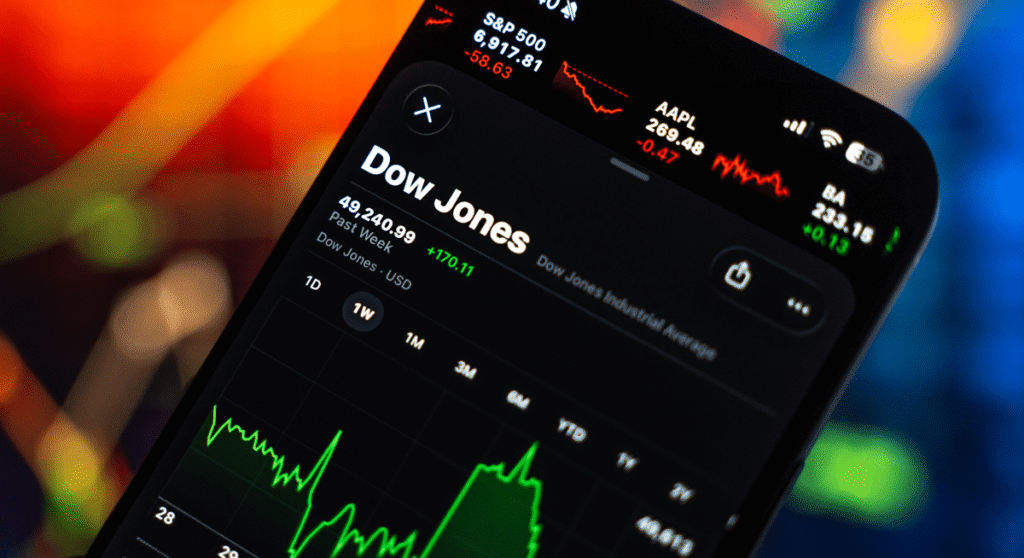
Reading DJIA futures involves understanding the quoted price, contract month, trading volume, and price movement. A futures quote usually identifies the contract and its current trading price, while a chart helps traders observe whether prices are rising, falling, or moving sideways.
Traders commonly use several indicators and market measures:
-
Price action: Shows the direction and pace of recent market movements.
-
Trading volume: Helps indicate how much trading activity accompanies a price move.
-
Support and resistance: Potential areas where buying or selling pressure may emerge.
-
Moving averages: Smooth price data to help identify trends over selected periods.
-
Economic calendar: Shows scheduled announcements that may cause volatility.
A futures price above the previous settlement price may indicate positive overnight sentiment, but it does not guarantee that the Dow will open higher or finish the day in positive territory. Prices can reverse quickly when new information reaches the market.
DJIA Futures Trading Strategies
Different traders use different approaches depending on their objectives, experience, and tolerance for risk. Some focus on short-term price movements, while others use futures to hedge an existing portfolio or manage exposure to US equities.
Day traders may study intraday charts, volume, and scheduled economic releases to identify possible entry and exit points. Swing traders may examine broader trends and hold positions longer, while hedgers may use futures to offset some of the risk associated with stock holdings. No strategy guarantees profits, and a method that works in one market environment may perform poorly in another.
Risk management is essential regardless of the approach. Traders can establish position limits, define exit conditions, and avoid risking money they cannot afford to lose. Stop orders may help manage exposure, although execution prices can differ from the intended stop price during fast or illiquid markets.
Risks of Trading Dow Jones Futures
DJIA futures offer market access and leverage, but they also involve substantial financial risk. Because traders control a large notional position with a comparatively smaller margin deposit, even a relatively modest index movement can produce a significant gain or loss.
Common risks include:
-
Leverage risk: Losses can accumulate quickly relative to the initial margin deposited.
-
Volatility risk: Economic announcements and unexpected news can cause sharp price movements.
-
Overnight risk: Prices may change substantially while traders are away from their screens.
-
Liquidity risk: Bid-ask spreads and execution conditions can become less favorable during volatile periods.
Traders should understand their broker’s margin requirements, contract specifications, and liquidation policies before opening a position. Margin is not a measure of the maximum possible loss, and traders may lose more than their initial deposit.
DJIA Futures vs. Dow Jones Index
Although DJIA futures and the Dow Jones index are closely connected, they serve different purposes. The index measures the performance of its constituent stocks, while futures are exchange-traded contracts whose prices reflect expectations about the index at a future settlement date.
|
Feature |
DJIA futures |
Dow Jones index |
|---|---|---|
|
Purpose |
Trade or hedge index exposure |
Measure stock-market performance |
|
Trading |
Futures exchange |
Index itself is not directly traded |
|
Leverage |
Available through margin |
Depends on the investment product used |
|
Trading hours |
Extended electronic sessions |
Calculated from constituent stock prices |
|
Expiration |
Futures contracts expire |
No futures-style expiration |
Futures prices can differ from the index’s current value because of interest rates, expected dividends, time to expiration, and supply and demand. This difference is commonly called the futures basis. Understanding it helps traders avoid interpreting every futures-price difference as a change in the underlying index’s value.
Conclusion
DJIA futures are an important part of the financial markets, offering a way to trade or hedge exposure to the Dow Jones Industrial Average. Their extended trading hours, standardized contracts, and availability in different sizes make them useful to a range of market participants. However, leverage, volatility, and margin requirements mean that understanding the contract is essential before trading.
For anyone following Dow Jones futures, the most useful starting points are the current futures quote, relevant economic announcements, corporate earnings, and the contract’s specifications. Combining those details with a clearly defined risk-management approach can help traders interpret market movements without treating every price change as a trading opportunity.
Frequently Asked Questions
1. What does DJIA futures mean?
DJIA futures are standardized financial contracts linked to the Dow Jones Industrial Average. They allow traders to take positions based on expected movements in the index and allow investors to hedge certain forms of equity-market exposure.
2. What is the ticker symbol for Dow Jones futures?
The main E-mini Dow futures ticker is YM, while Micro E-mini Dow futures use MYM. CME Group also introduced E-nano Dow futures, which use the symbol NDOW.
3. Can you trade DJIA futures overnight?
Yes. Dow futures trade during extended electronic sessions, providing opportunities to respond to developments outside regular US stock-market hours. Trading schedules include daily breaks and may vary around holidays.
4. What is the difference between E-mini and Micro E-mini Dow futures?
E-mini Dow futures have a multiplier of $5 per index point, whereas Micro E-mini Dow futures have a multiplier of $0.50 per point. The Micro contract is one-tenth the size of the E-mini, so the dollar impact of a given index movement is correspondingly smaller.
5. Are DJIA futures suitable for beginners?
Beginners can study DJIA futures to understand market expectations, but trading them requires knowledge of leverage, margin, contract expiration, and volatility. Smaller contract sizes do not eliminate the possibility of substantial losses. Learning how futures work and practicing with a simulated account can help newcomers understand the mechanics before risking real money.