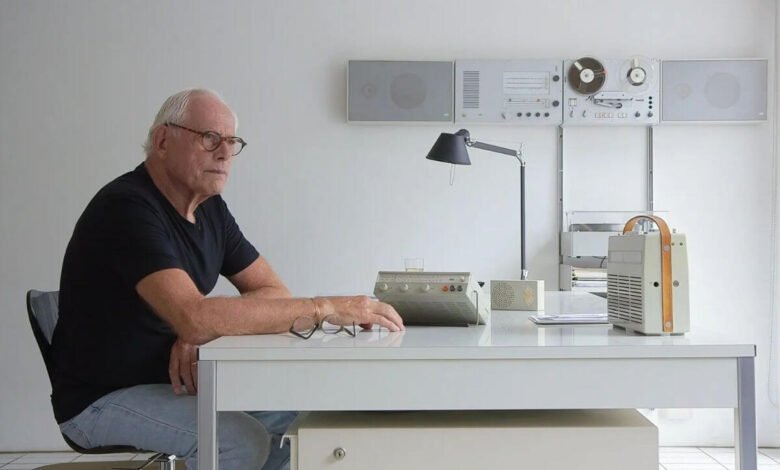
Dieter Rams is one of the most influential industrial designers of the modern era, best known for transforming the visual and functional language of Braun products and for developing a philosophy centered on clarity, usefulness, restraint, and longevity. Born in Wiesbaden, Germany, in 1932, Rams initially studied interior design and later trained as an architect before joining Braun in 1955. His background in architecture helped shape an approach that treated products not simply as isolated objects, but as carefully organized elements within everyday life. The Design Museum describes him as a designer who established an elegant, rigorous visual language at Braun, while other major design institutions continue to recognize his work as a foundation of modern product design.
Rams became particularly important because he challenged the idea that a successful product needed excessive decoration to attract attention. Instead, he believed that designers should understand what people actually need and then remove everything that distracts from that purpose. This sounds simple, but it is surprisingly difficult to achieve. Think of his philosophy like editing a great piece of writing: the goal is not to add more words, but to remove everything unnecessary until the essential message becomes unmistakable. That mindset made Dieter Rams design recognizable for its clean geometry, restrained colors, logical controls, and strong relationship between appearance and function.
Early Life and Education
Rams’ early experiences helped establish the foundations of his later design philosophy. He was strongly influenced by his grandfather, who worked as a carpenter, and Rams later described the craft tradition and practical tools of ordinary workers as important influences on his thinking. He studied interior design in Wiesbaden and also completed a carpentry apprenticeship before developing his architectural interests. After graduating, he worked in an architecture office in Frankfurt before joining Braun in 1955.
That combination of craft, architecture, and practical problem-solving became visible throughout his career. Rams did not treat design as decoration applied after engineering was complete. Instead, he approached the entire object as a unified system. Materials, proportions, controls, colors, manufacturing requirements, and user interaction all had to work together. His work therefore feels remarkably calm, even when the products themselves contain complicated technology. The technology is present, but it does not need to shout.
Dieter Rams and Braun
Rams’ relationship with Braun became the defining chapter of his professional career. When he joined the company, Braun was developing a new generation of consumer electronics during a period of rapid technological change. Rams initially worked on interiors and exhibitions, but his attention increasingly moved toward product design. In 1956, he worked with Hans Gugelot and Braun colleagues on the SK4 radio and record player, a product that became a landmark in modern industrial design.
The SK4 rejected the traditional idea that a radio or record player should resemble a piece of furniture. Its transparent lid exposed the mechanics rather than hiding them inside an ornamental cabinet. The result was strikingly different from many products of its time and helped establish a visual direction that Braun continued developing. Rams subsequently worked on increasingly coherent product families, where individual components could share dimensions, colors, controls, and proportions. This consistency was not simply about creating a recognizable brand. It also made products easier to understand and combine.
The SK4 and a New Design Language
The SK4 demonstrated one of Rams’ most important ideas: technology does not need decorative camouflage. Instead of pretending that a technological object was something else, the design could honestly reveal its purpose and construction. That approach helped make the product feel modern without depending on temporary fashion.
Rams later developed a broader Braun design language characterized by orderly controls, modular dimensions, restrained colors, and clear visual hierarchy. By the 1960s, he had become director of Braun’s design team, overseeing a growing group of designers and shaping products across categories including radios, record players, projectors, clocks, calculators, and other consumer goods. The Design Museum notes that Rams worked at Braun for decades and oversaw hundreds of products during his career.
Dieter Rams’ Design Philosophy
At the heart of Dieter Rams’ philosophy is a deceptively powerful idea: good design should improve people’s lives without demanding unnecessary attention. His approach can be summarized through the phrase “Less, but better.” Rather than treating minimalism as an aesthetic trend, Rams connected simplicity with usefulness, durability, honesty, and responsibility.
This distinction matters. A product can look minimalist while still being confusing or poorly designed. Rams’ minimalism was not about making an object visually empty. It was about ensuring that every remaining element had a reason to exist. A button should communicate its function. A surface should support use. A proportion should contribute to the overall object. A material should make sense. When these decisions work together, simplicity becomes the result of careful thinking rather than the absence of thinking.
What “Less, but Better” Really Means
“Less, but better” is often associated with clean visual design, but Rams’ concept goes much deeper. His goal was to concentrate on essentials and eliminate unnecessary features and visual noise. Vitsœ, the company that has worked with Rams for decades, describes the principle as returning to purity and simplicity by avoiding non-essential elements.
The philosophy is especially relevant today because people interact with an enormous number of products, interfaces, notifications, advertisements, and digital services. When everything competes for attention, clarity becomes valuable. Rams’ work suggests that the best designer is not necessarily the person who adds the most features, but the person who understands which features deserve to remain.
The Ten Principles of Good Design
Rams eventually articulated his philosophy through ten principles for good design. They became one of the most widely discussed frameworks in modern industrial design. The principles address innovation, usefulness, aesthetics, comprehension, unobtrusiveness, honesty, longevity, attention to detail, environmental responsibility, and restraint. Rams himself has emphasized that the principles should not be treated as unchangeable rules because design continues to evolve with technology and culture.
Innovation and Usefulness
The first principles state that good design is innovative and that good design makes a product useful. For Rams, innovation was not novelty for novelty’s sake. New technology should create meaningful opportunities for better products rather than becoming an excuse for unnecessary complexity.
Usefulness is equally fundamental. A beautiful object that fails to serve its purpose is not successful design by Rams’ standards. He believed a product should satisfy functional, psychological, and aesthetic needs while avoiding features that interfere with its usefulness.
Honesty, Durability, and Simplicity
Rams also argued that good design should be understandable, unobtrusive, honest, durable, thorough down to the last detail, environmentally responsible, and based on as little design as possible. These ideas are remarkably connected. An honest product does not pretend to be something it is not. A durable product avoids becoming obsolete simply because its appearance follows a temporary fashion. An environmentally responsible product considers resources and waste rather than focusing only on the moment of sale.
His principle of durability is especially interesting in an age of rapid product cycles. Rams believed good design should avoid becoming fashionable and therefore should remain relevant for many years. That idea turns design into something closer to stewardship than decoration.
Dieter Rams’ Most Influential Designs
Throughout his career, Rams contributed to a remarkable range of products. His Braun work included audio equipment, radios, clocks, calculators, projectors, and other household technologies. Products such as the SK4, Audio 1 system, T1000 world receiver, and various Braun calculators demonstrate his commitment to coherent systems and easily understandable controls. The Design Museum’s historical record highlights the development of many of these products throughout the 1950s, 1960s, and 1970s.
Braun Products and Audio Equipment
The importance of Rams’ Braun work lies not in one isolated product but in the system he helped establish. Components were often designed to share proportions and could be arranged in different configurations. Controls were carefully positioned, colors were restrained, and visual hierarchy helped users understand what mattered. The result was a product family that felt consistent without becoming monotonous.
That approach anticipated a major principle of contemporary technology design: a product ecosystem should feel coherent. Whether someone is looking at a calculator, radio, or audio component, familiar visual logic can reduce the learning curve. Rams understood that consistency is not merely branding; it can be a form of communication.
The 606 Universal Shelving System
Rams’ work was not limited to electronics. His 606 Universal Shelving System, developed for Vitsœ, demonstrates how his principles could operate in furniture. The system was designed around flexibility, modularity, and long-term usefulness, allowing users to configure storage according to changing needs. The system has remained in production for decades, making it an especially clear example of Rams’ belief that good design should resist short-lived fashion.
The 606 also reveals an important part of Rams’ thinking: good design can create freedom rather than impose a single arrangement. Instead of telling the user exactly how a room must look, a modular system allows the environment to evolve. That is a quiet but powerful form of user-centered design.
Dieter Rams and Apple’s Design Influence
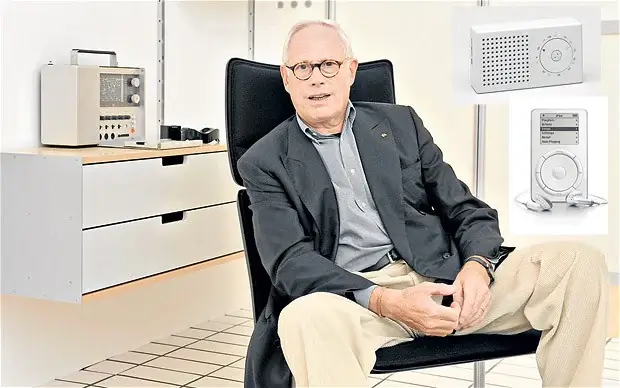
One of the most frequently discussed aspects of Rams’ legacy is his influence on later technology designers, particularly at Apple. Design institutions have repeatedly identified similarities between Rams’ Braun products and the visual language of later Apple products. The Design Museum specifically notes Apple’s relationship with Rams’ work and identifies Apple among the companies strongly influenced by his approach.
The comparison makes sense when looking at shared themes such as restrained interfaces, simple physical forms, careful typography, limited visual clutter, and strong attention to how technology communicates with its user. Jony Ive, Apple’s former chief design officer, is among the designers whose work has been associated with Rams’ influence. Vitsœ also identifies Ive, Naoto Fukasawa, and Jasper Morrison among designers who have acknowledged Rams’ impact.
Why His Ideas Still Matter
Rams’ relevance has actually grown as technology has become more complicated. A modern device can perform hundreds of tasks, but that does not mean the user should have to understand all of them at once. His philosophy offers a useful reminder that complexity should exist behind the scenes whenever possible.
In that sense, Dieter Rams design is not merely a historical style. It is a method of thinking. Designers can apply it to websites, apps, appliances, furniture, packaging, and digital interfaces by asking a simple question: does every element help the user, or is it simply there because someone thought it looked impressive?
Dieter Rams and Sustainable Design
Environmental responsibility was an important part of Rams’ philosophy long before sustainability became a dominant design conversation. His ninth principle states that good design should be environmentally friendly, including the conservation of resources and reduction of physical and visual pollution across a product’s lifecycle.
This makes Rams particularly relevant today. A product designed to survive longer can reduce the pressure created by constant replacement. A timeless product may remain useful even when fashions change. A modular product can potentially adapt rather than being discarded entirely. Rams’ work therefore connects visual restraint with a broader ethical question: what responsibility does a designer have for the objects entering people’s lives?
His philosophy does not suggest that every product must be simple for simplicity’s sake. Instead, it asks designers to consider consequences. If a feature does not improve the experience, why manufacture it? If an object becomes useless after a short period because of fashion, was its design truly successful? These questions make Rams’ work feel surprisingly contemporary.
Dieter Rams’ Legacy
Dieter Rams’ legacy extends far beyond the products he designed at Braun. Museums around the world have exhibited his work, while his furniture designs continue to be produced. The 606 Universal Shelving System is held in the permanent collection of the Museum of Modern Art in New York, and the 620 Chair Programme is part of the Victoria and Albert Museum’s collection.
His ideas have also entered mainstream design vocabulary. Terms such as minimalism, user-centered design, timelessness, modularity, and visual clarity are now common, but Rams helped demonstrate how these principles could operate together in real products. His 2018 documentary, Rams, introduced his work and philosophy to another generation, while design exhibitions continue to examine his contribution.
Perhaps the most important part of his legacy is that Rams never treated his principles as a rigid formula. The Rams Foundation explains that the principles represent fundamental considerations in his work, while acknowledging that ideas about good design continue to evolve alongside technology and culture. That flexibility keeps his philosophy alive rather than freezing it as a museum artifact.
Conclusion
Dieter Rams changed industrial design by demonstrating that simplicity can be the product of deep thought rather than a lack of imagination. His work at Braun established a distinctive language based on usefulness, clarity, honesty, durability, and disciplined visual organization, while his furniture work showed that the same ideas could shape entire living environments. His famous principle of “less, but better” remains powerful because it asks designers to focus on what truly matters instead of adding complexity simply because technology makes it possible.
Today, Rams’ influence can be seen in product design, technology, furniture, architecture, and digital experiences. His ten principles continue to provide a practical framework for thinking about what makes an object useful, understandable, responsible, and enduring. In a world increasingly filled with visual noise and disposable products, his central message feels almost radical: design should make life better, not simply make more things.
FAQs About Dieter Rams
Who is Dieter Rams?
Dieter Rams is a German industrial designer born in Wiesbaden in 1932. He became internationally known through his long career at Braun, where he helped establish a highly influential visual and functional design language. He also designed furniture for Vitsœ and developed his famous ten principles of good design.
What is Dieter Rams famous for?
Dieter Rams is best known for his work at Braun and his philosophy of “less, but better.” His designs emphasized functionality, simplicity, clarity, durability, and careful attention to detail. Products such as the SK4 and his Braun audio equipment became important examples of modern industrial design.
What are Dieter Rams’ ten principles?
Rams’ ten principles say that good design is innovative, useful, aesthetic, understandable, unobtrusive, honest, long-lasting, thorough down to the last detail, environmentally friendly, and based on as little design as possible.
Did Dieter Rams influence Apple?
Yes. Major design institutions and Vitsœ identify Dieter Rams as an important influence on later designers, including Apple’s former design leader Jony Ive. Similarities are often discussed between Rams’ Braun products and Apple’s restrained approach to technology design.
What does “less, but better” mean?
“Less, but better” means removing unnecessary elements so that a product can focus more clearly on its essential purpose. For Rams, simplicity was not merely about appearance; it involved usefulness, clarity, durability, responsibility, and respect for the user.