SpaceX has won permission to put up to one million satellites into orbit to build data centers in space. The US Federal Communications Commission (FCC) gave its approval on Wednesday, 25 November 2026, for the company’s Starmind constellation — the first time the regulator has ever approved a full constellation of data centers in space.
It is a big regulatory win for Elon Musk’s company, but it is only the first step. No Starmind satellite has been built or launched yet, and SpaceX has until 2033 to get the first one into orbit. As Reuters reported the FCC’s decision, the approval helps meet the rapidly growing demand for AI computing power — if the technology works at this scale.
What is Starmind?
Starmind is SpaceX’s plan for a network of up to one million “orbital compute modules” — satellites that work together as data centers in low Earth orbit, processing AI workloads in space and sending the results back down to Earth.
SpaceX filed its application with the FCC on 30 January 2026. The company describes Starmind as “capturing solar energy in space to power low-cost, high-performance AI compute for Earth.” Instead of building more data centers on the ground, SpaceX wants to put the computers in orbit, where they can run on constant sunlight.
The satellites would link to each other using lasers, and to SpaceX’s Starlink network, with radio links kept as a backup for control and emergencies. In August 2026, SpaceX said it is working with Nvidia on the project: each Starmind satellite will carry Nvidia Rubin GPUs and Vera CPUs, the kind of chips used in ground-based AI data centers.
What the FCC approval actually allows
The approval comes with strict deadlines. SpaceX must:
- Deploy its first Starmind satellite by November 2033
- Deploy 100,000 satellites — 10% of the total — by November 2035
- Deploy 500,000 satellites — half the total — by November 2038
- Deploy the full one million satellites by November 2040
If SpaceX misses a deadline, the approval can expire. The company plans to move faster than that: chief financial officer Bret Johnsen said last week that SpaceX aims to launch its first space data centers in 2027 and expand through 2029.
The scale is hard to picture. SpaceX’s Starlink internet network, already the largest satellite constellation ever built, has just over 11,000 satellites in orbit. Starmind would be about 90 times bigger.
The approval is also conditional. The FCC has not yet approved how SpaceX will handle orbital debris for satellites flying above 600 kilometres. SpaceX asked for permission to move old satellites into so-called graveyard orbits at the end of their lives instead of bringing them down to burn up in the atmosphere. The FCC did not grant that waiver, and it wants a detailed debris plan before those higher orbits are used.
Why put data centers in space?
Demand for AI computing is growing fast, and data centers on Earth need huge amounts of land, electricity and cooling water. SpaceX’s argument is that orbit solves two of those problems: satellites get sunlight almost all the time, so solar power is cheap and constant, and space itself is cold.
That is the theory. In practice, nobody has ever run a data center in orbit, and the cost of launching a million satellites — even for SpaceX, the world’s most frequent launcher — would be enormous. As TechCrunch’s breakdown of the approval conditions notes, this first approval does not mean orbital data centers are imminent.
Why scientists and rivals object
Not everyone is happy. The American Astronomical Society, satellite company Viasat and Amazon’s Kuiper broadband unit all asked the FCC to deny the application. Their worries are orbital debris, congestion in low Earth orbit, radio interference, and damage to astronomy.
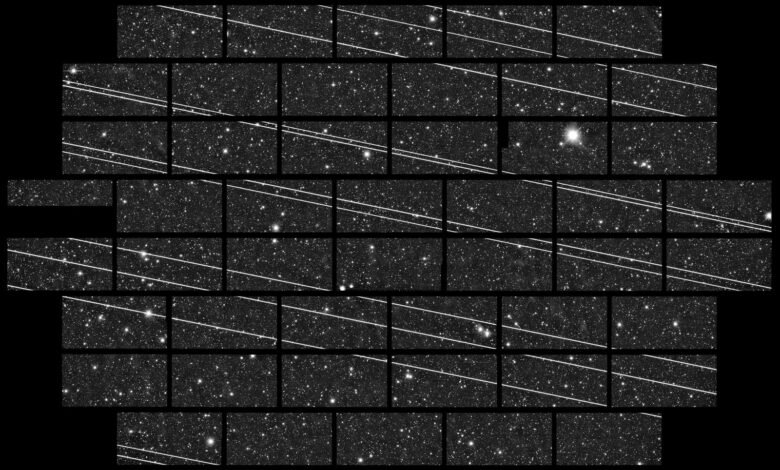
Astronomers already struggle with Starlink. Bright satellite trails cross telescope images and can ruin long exposures — the streaks in the photo above were left by Starlink satellites passing over an observatory in Chile in 2019, when the constellation was still tiny. A network 90 times larger would be far harder to work around, and the American Astronomical Society said it would undermine decades of federal investment in astronomy facilities.
FCC chairman Brendan Carr dismissed those concerns in the agency’s announcement, saying “America is leading the world into the era of super intelligence.” The FCC said Starmind is consistent with its orbital debris rules, and it attached conditions requiring communications backups, regular progress updates and a detailed debris mitigation plan.
What happens next
SpaceX now has to prove the idea works. The first test satellites are expected in 2027, and a filing linked to the company’s public offering said its Bastrop, Texas, facility will build the AI compute satellites, while its Redmond, Washington, site keeps making Starlink satellites.
Whether one million satellites ever actually launch is still an open question. The approval allows up to a million — it does not require it — and each milestone deadline is a test SpaceX must pass to keep the licence.
The approval caps a busy month for SpaceX, which also caught a Starship upper stage for the first time on Flight 15 earlier in November. For now, Starmind is a permit, not a product. The next real test comes when the first satellite reaches orbit.
FAQs
When will the first Starmind satellite launch?
SpaceX plans its first launches in 2027. The FCC requires at least one satellite in orbit by November 2033, or the approval expires.
Is Starmind the same as Starlink?
No. Starlink provides internet service from orbit. Starmind would process AI workloads in space. The two networks would share laser links, but they are separate systems.
Will there really be a million satellites?
Nobody knows yet. The FCC approval allows up to one million, but SpaceX must hit each milestone — 100,000 by 2035, half a million by 2038 — or lose the licence.